
ithout a clear approach, it is easy for content to fall short of the expected impact and for efforts not to translate into tangible results.
In this article, we explain what a content marketing plan is, why it is crucial for your business and how to create one that allows you to achieve your objectives. From defining your target audience to measuring results, we guide you step by step so you can develop an effective content strategy that drives your brand and achieves sustainable growth.
Carry Out a SWOT Analysis
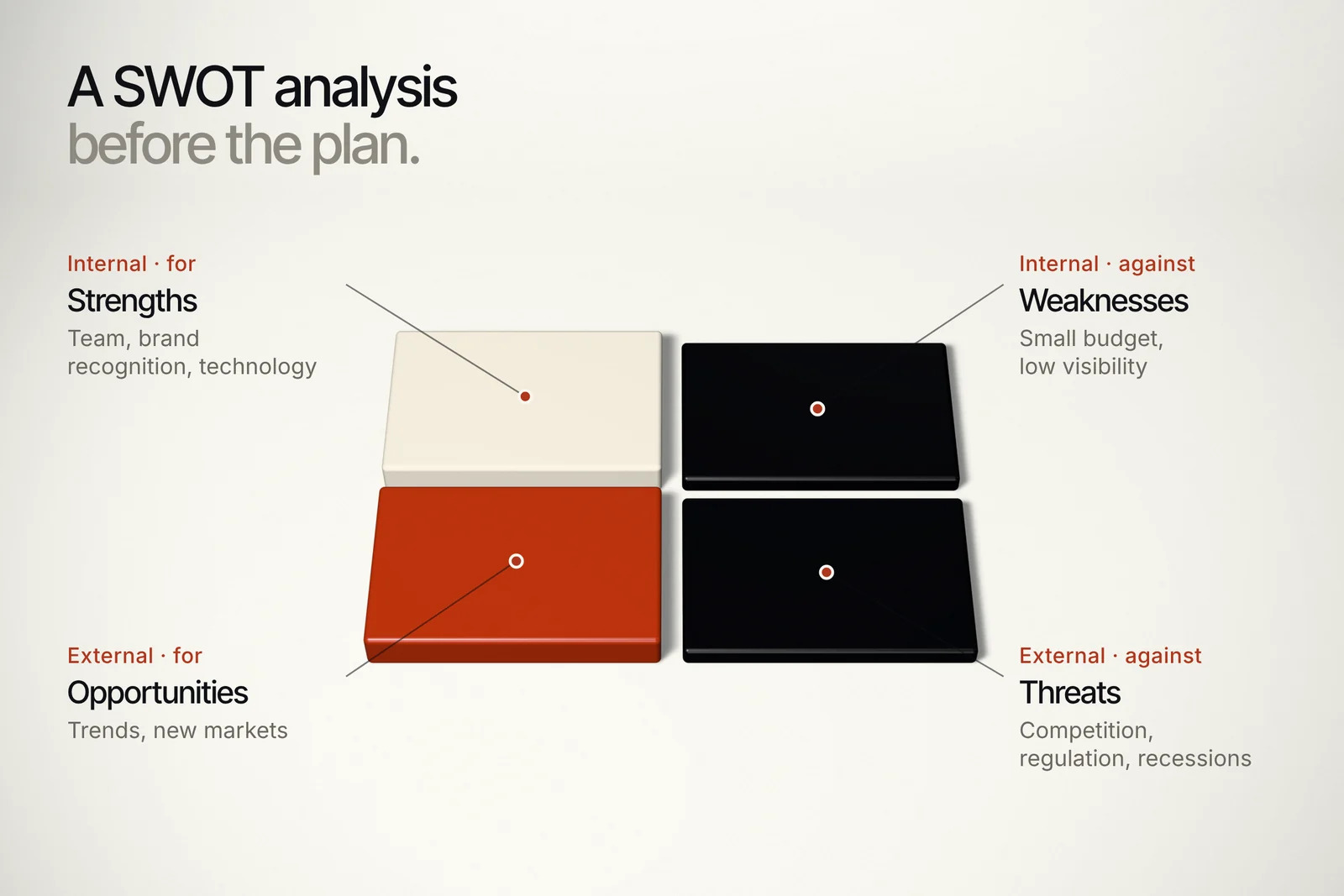
A SWOT analysis (known as FODA in Spanish) is a strategic planning tool that helps identify and evaluate the four key aspects of a business: Strengths, Weaknesses, Opportunities and Threats. It is a simple but powerful technique that helps business owners identify the internal factors (strengths and weaknesses) and external factors (opportunities and threats) that can affect their success.
Strengths (S)
Strengths are the positive internal aspects of your business. They are the characteristics that set you apart from the competition and give you a competitive advantage in the market. They are factors you can control and build on to achieve success. Some examples of strengths:
- A talented, committed team: If your company has a highly qualified team, that becomes a major strength. Your team’s knowledge, creativity and dedication can make a big difference.
- A recognised brand: If you already have a solid, well-known brand, that is an important strength. Your customers’ trust and your recognition in the market are assets that should not be underestimated.
- Advanced technology or quality infrastructure: Having access to cutting-edge technology or modern facilities can also be a strength that improves the efficiency and quality of your product or service.
Weaknesses (W)
Weaknesses are internal aspects of your business that limit your ability to achieve your objectives. They are areas that need to be improved or that, in their current state, represent an obstacle to growth. Some examples of weaknesses:
- Lack of financial resources: If your company is limited by a low budget or does not have access to adequate funding, this can restrict your opportunities to expand or improve your processes.
- Low brand visibility: If your company does not yet have a significant presence in the market, or if you have not developed an effective marketing strategy, this could be a weakness to overcome.
- Dependence on a single supplier or customer: If your business depends too heavily on one supplier or one customer, this can jeopardise the stability of your company if something changes with them.
Opportunities (O)
Opportunities are external factors that could benefit your business. They are situations, trends or changes in the environment that you can take advantage of to grow or improve your competitive position. Some examples of opportunities:
- Emerging consumer trends: If you spot a new trend in consumer behaviour, such as growing interest in eco-friendly products, you can adapt your offering to take advantage of that demand.
- Expansion into new geographic markets: If you find there is unmet demand in a local or international market, this can be a great opportunity to expand your business.
- Technological advances: New technologies, such as automation or social media, can open up new ways to improve efficiency or increase your company’s visibility.
Threats (T)
Threats are external factors that can jeopardise the success or stability of your business. They are circumstances you cannot control directly, but which you must anticipate and manage. Some examples of threats:
- Growing competition: If new companies are entering your market with lower prices or more innovative products, this represents a threat to your market share and profitability.
- Regulatory or legislative changes: If new laws or regulations are introduced that affect your industry, such as tax increases or new environmental rules, this can generate additional costs or operational changes.
- Economic crises: Economic recessions can affect demand for products or services, which represents a significant threat if your business depends on high sales volumes.
Define Your Buyer Persona
A buyer persona is a detailed profile that describes your ideal customer, including their demographic characteristics, interests, behaviours and needs. This profile helps companies better understand their consumers and adapt their marketing and sales strategies to offer more relevant solutions. Unlike simple market segmentation, a buyer persona provides deeper insight into the motivations, goals and challenges of potential customers, enabling more effective, persuasive communication.
In this step, you need to call on your creativity and start building a simulation of who your ideal customer is, including specific characteristics that help you understand their interests, desires, limitations, fears, obstacles, consumption networks and so on. This is the most important step, because your content marketing plan must meet every one of your ideal customer’s needs.
A buyer persona should contain key information such as:
- Demographic data: age, gender, location, level of education, family situation and occupation. These factors influence purchase decisions and the way the user interacts with a brand.
- Interests and behaviours: hobbies, the social networks they use, buying habits, the type of content they consume and the communication channels they prefer.
- Needs and challenges: the problems they face in their daily lives and how your product or service can help them solve them efficiently.
- Motivations and objections: the emotional and rational factors that influence their purchase decisions, as well as the main barriers that could prevent the user from choosing your product or service.
Identify Your Direct and Indirect Competitors
Now it is time to carry out research to get to know your direct and indirect competitors properly, with the aim of examining what their content activity looks like.
Write SMART Objectives
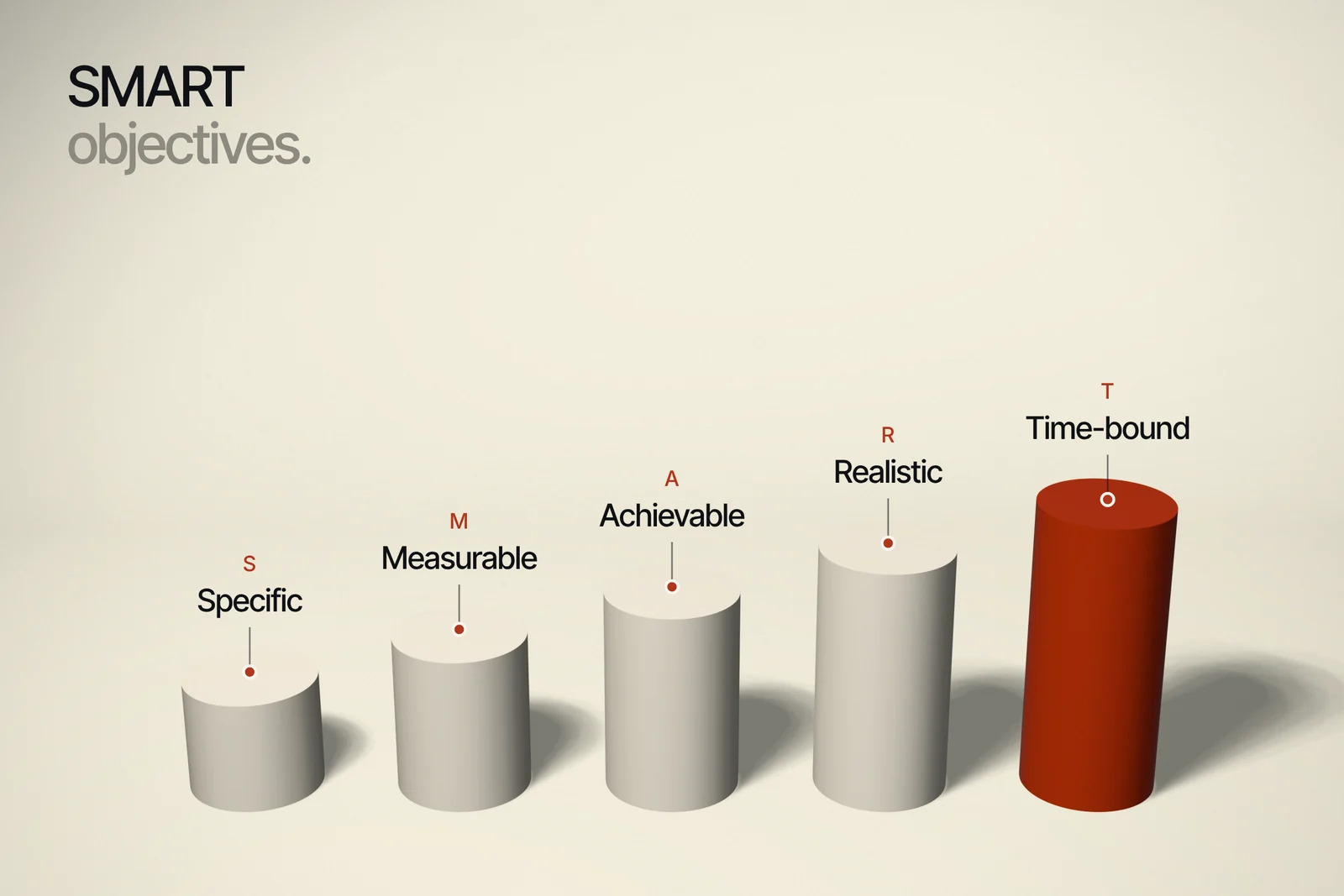
You have probably already heard of SMART objectives: these are goals you need to define for your brand in order to understand where you want to get to. They are called SMART because they must meet the different criteria we set out below:
- Specific: your objectives must be specific, which means you have to write goals that are as explicit as possible, avoiding generalities.
- Measurable: goals must be measurable, so you need to include elements that make it possible to understand whether or not the objective has been met. The famous KPIs.
- Attainable: objectives should be ambitious but achievable, so you need to know the possible limitations you will encounter when implementing the content marketing plan.
- Realistic: when setting your objectives, they must be realistic. It sounds obvious, but goals are often written that are difficult to achieve, whether because of the market, your business’s resources or the limitations of your ideal customer.
- Timely: define a maximum and minimum period within which you want to start seeing results.
Establish Strategies and Actions
This may be the most complex part of your content marketing plan, but it is the moment to determine which strategies to pursue (and to do that you need to understand your conversion funnel) and the actions that will ensure those strategies are delivered.
Decide on the Channels and Media to Use
Every brand needs to understand the resources it has, but once your buyer persona and SMART objectives are ready, it is possible to work out which channels or media you should use to achieve them. You can also feed your decision-making with the research you have carried out on your competitors.
THE MISTAKE
Don’t limit yourself to choosing a single channel or medium in your content marketing plan. There is no exact number; it all depends on the analysis you have carried out previously and the resources you have available.
Write the Messages to Share
Now that you have all the relevant elements, it is time to call on your creativity and start writing the messages that will be shared on each of the chosen channels. If the previous steps are right, this one comes together on its own.
Build an Editorial Calendar
You have probably already heard the term “editorial calendar”: it is a kind of roadmap in which you set out which messages will be shared through each chosen medium and the objective you want to achieve, so that you can understand whether or not it has been effective.