oday, Instagram works as a commercial channel capable of guiding a user from the first impression to the final purchase. The businesses that manage to turn followers into customers do not rely on luck or a stroke of virality: they build strategic, defined, measurable funnels. An Instagram sales funnel is a precise architecture in which every piece of content plays a role, every interaction opens a door and every stage moves the user towards a decision.
What Is an Instagram Sales Funnel?
An Instagram sales funnel is a structured process that guides the user from discovering your brand through to conversion and loyalty. It works like any traditional funnel, but adapted to the platform’s own codes, dynamics and formats. Instagram currently has both benefits and limitations that you should be aware of before investing time and resources. The stages of an effective conversion funnel for Instagram are:
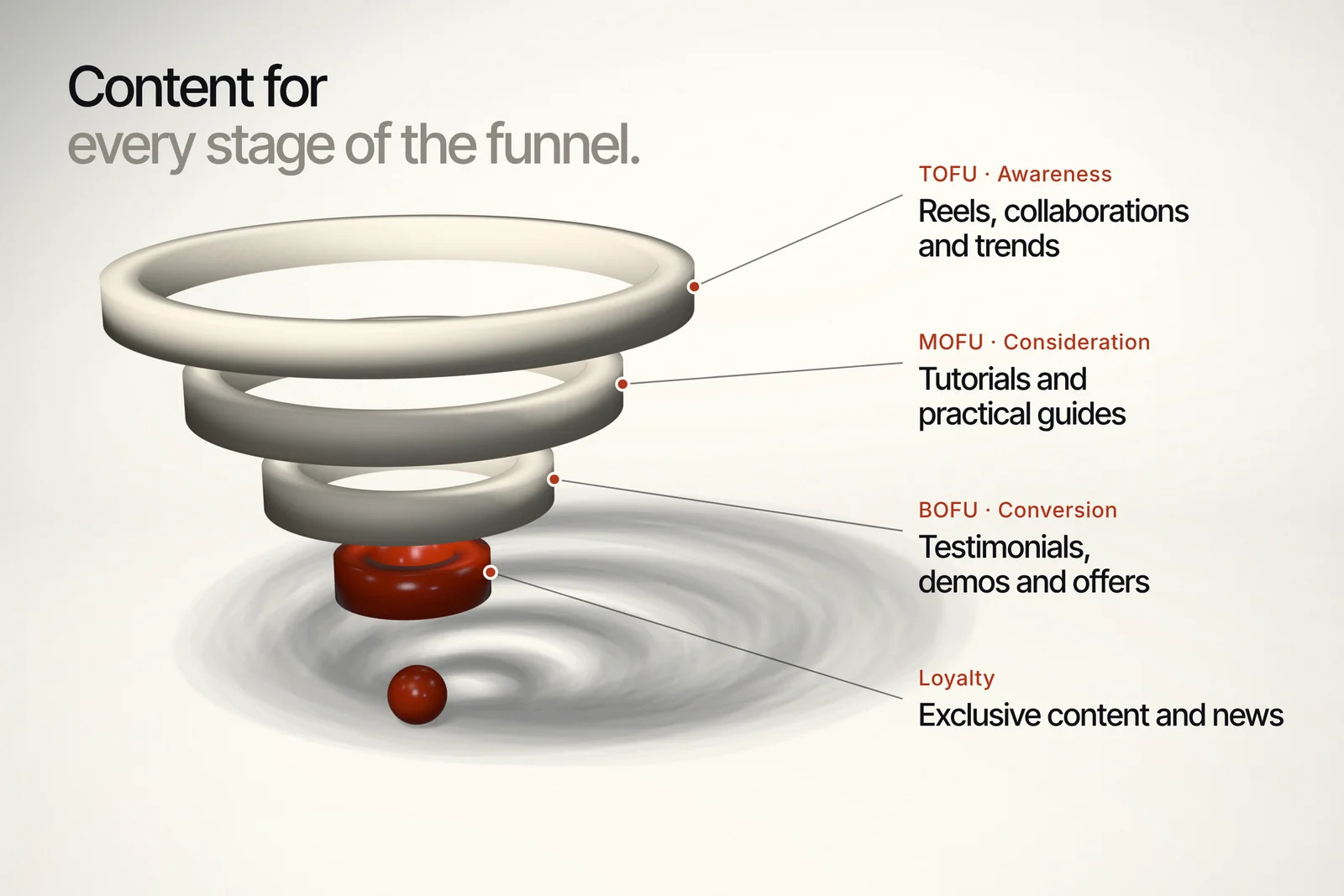
TOFU – Awareness
This is the stage where the user discovers your brand. Your objective is simple, but powerful: to be visible and relevant. Nothing is sold here; interest is awakened. Content should attract, inspire and generate immediate affinity.
The most effective content for the brand awareness stage is Reels, collaborations, trends, aspirational content and high-impact posts that stop the scroll and spark immediate curiosity.
MOFU – Interest and Consideration
At this point, the user already knows you exist and starts to evaluate you. They look for information, compare and research whether your solution is for them. This is the space for education, social proof and tangible value.
Unlike the top of the funnel, in the middle of the conversion funnel the most effective content is: tutorials, practical guides, behind-the-scenes stories, comparisons, success stories and educational content that establishes authority.
BOFU – Conversion
The user is ready to decide. They need clarity, confidence and a final nudge. This is where offers, demonstrations or direct calls to action come into play. It is the moment when every message can decide a sale.
To publish valuable content suited to the bottom-of-funnel stage, what we at FlowFlamingo recommend is: testimonials, demonstrations, limited-time offers, calls to action via DM, concrete benefits and posts focused on overcoming objections.
Loyalty – Retention and Repeat Purchases
The sale is not the end, but a new stage. Loyalty turns customers into active followers and repeat buyers. A happy customer can be your best organic multiplier.
To cover the loyalty stage with an effective strategy, you can consider: exclusive content, advanced tips, news for customers, polls, rewards and personalised communication via direct messages.
How to Build an Instagram Sales Funnel
Building an Instagram sales funnel is not just about publishing attractive or viral content. It is a strategic process in which every action, every format and every interaction must push the user one step closer to conversion. Below, we show you how to design a complete, functional funnel.
1 – Define Your Buyer Persona
Before taking any action, it is essential to know who you are selling to. In B2C this can be simple, but on Instagram the user is still an individual with specific motivations, interests and objections. Defining your buyer persona makes it possible to create precise messages, choose suitable formats and anticipate objections before they arise.
2 – Clarify Your Core Offer
The user must immediately understand what you offer, why it is different and which problem it solves. The offer should be:
- Specific: leaving no room for interpretation.
- Differentiated: highlighting benefits over the competition.
- Visually communicable: able to be explained in a Reel, Story or post.
3 – Develop Content for Each Funnel Stage
Content is not just aesthetics: it is direction, guidance and sales argument. Each stage requires a different approach:
- TOFU (Awareness): attractive, inspiring, aspirational content that stops the scroll and generates curiosity. E.g. viral Reels, collaborations, trends, UGC.
- MOFU (Consideration): educational, persuasive content that explains your value proposition and answers questions. E.g. tutorials, success stories, comparisons.
- BOFU (Conversion): direct content, with clear CTAs and concrete benefits. E.g. testimonials, demonstrations, limited-time offers.
- Loyalty: exclusive, educational, follow-up content that keeps the customer engaged and encourages repeat purchases.
4 – Optimise Your Instagram Profile
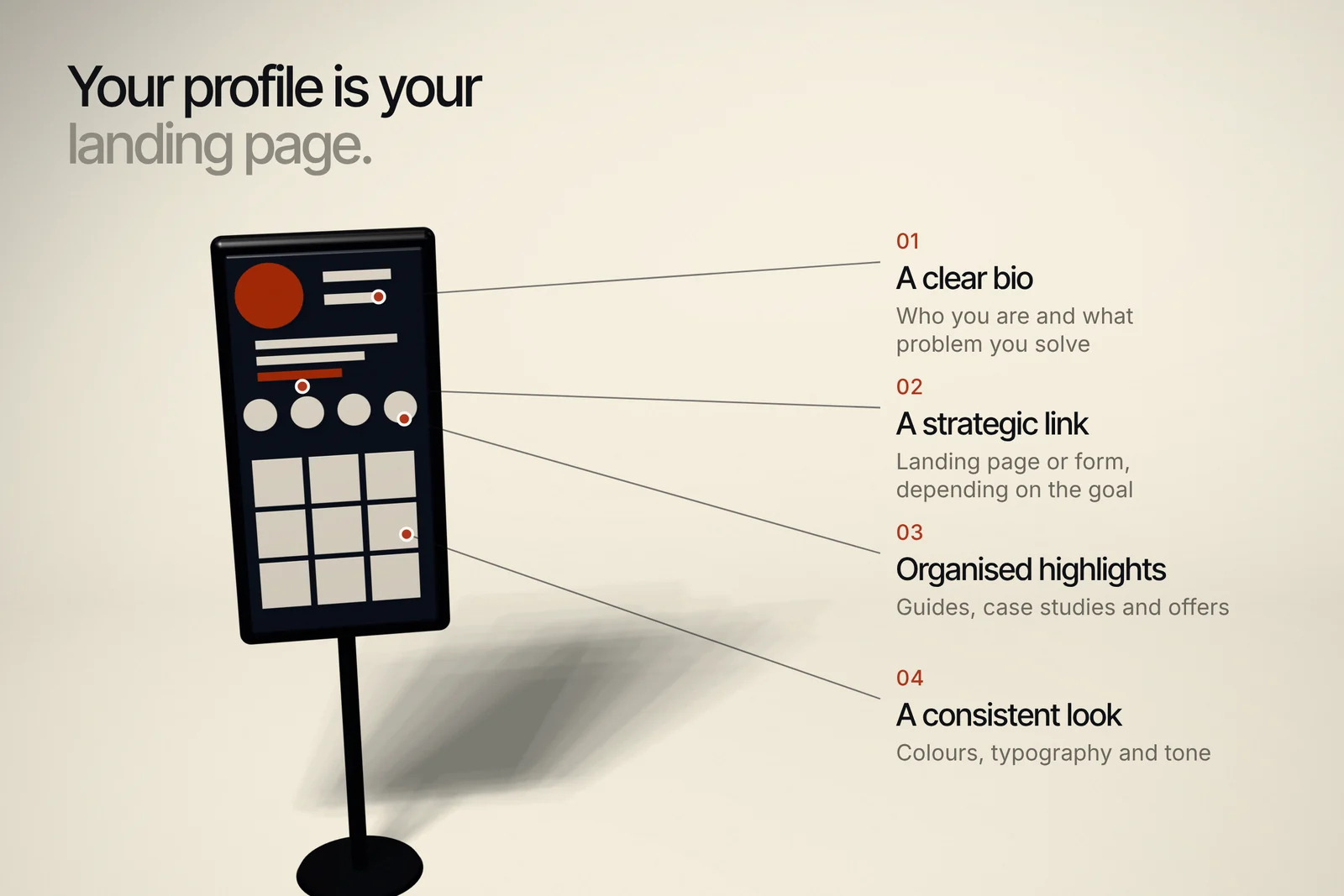
Your profile is more than a shop window: it is a landing page that must convert. Some key elements:
- Clear bio: communicate who you are and what you solve in a few words.
- Strategic link: a Linktree, a specific landing page or a form, depending on the objective.
- Organised Highlights: guides, success stories, tutorials, offers.
- Consistent aesthetics: colours, typography and tone aligned with the brand.
5 – Analyse Performance and Optimise
The funnel is not built just once; it evolves. Measure and adjust:
- Reach and engagement by stage
- Clicks on links and forms
- Conversion by content type
- How long users take to move through each phase
- Retention and repeat purchases
10 Common Instagram Sales Funnel Mistakes
Designing an Instagram sales funnel looks simple, but most brands stumble over the same obstacles. They are silent mistakes, small misalignments that erode conversions and turn a solid strategy into a system that falls short. Understanding them, and avoiding them, is as important as building the funnel well.
- Publishing without a clear strategy: many businesses create content at the pace of urgency, not purpose. This produces scattered posts with no coherence or connection between them. A funnel demands logic, progression and a clear path that accompanies the user step by step. Without a strategy, Instagram becomes a pretty mural… but a commercially ineffective one.
- Trying to sell too early: the most common mistake: pressing the user to buy when they do not yet trust you, do not understand the value or do not even know who you are. On social media, rushing is counterproductive. The process must seduce before it convinces. Selling at TOFU is like proposing marriage on the first date.
- Failing to guide people between funnel stages: a good funnel is not based on publishing more, but on publishing with intention. Every piece must push the user one step forward. Without clear CTAs (“swipe”, “message us”, “check the link”), the user is left floating without moving on, however brilliant the content they see.
- Having a disorganised or unclear profile: the bio, the Highlights, the profile photo and the link must act as a coherent ecosystem. If the user cannot understand what the brand offers within five seconds, they are unlikely to stay. A disorganised profile breaks trust and weakens any attempt at conversion.
- Creating content that serves no funnel stage: many businesses produce aesthetic pieces… with no function. They do not nurture, educate, attract or sell. A powerful funnel requires content designed like cogs: each piece plays a precise role in moving the user forward. If it does not add anything, it gets in the way.
- Not using clear calls to action (CTAs): silence is a mistake too. Not telling the user what to do next leaves them without direction. CTAs are not aggressive; they are compasses. A funnel without CTAs is a bridge with no exit.
- Failing to measure results properly: Instagram offers data in abundance, but many brands only look at likes and comments. A funnel is evaluated with business metrics: clicks, leads, conversations started, conversions and retention. What is not measured is guessed. And in business, guessing is losing.
- Not optimising based on real data: the funnel is a living organism. Formats, algorithms and buying behaviours change. Sticking with the first version condemns it to stagnation. Constant adjustment is what turns an ordinary funnel into a growth machine.
- Relying entirely on visual content: Instagram is visual, yes, but a funnel demands mental structure, narrative, consumer psychology and a well-built commercial flow. Images attract, but strategy converts. Relying on design alone is like painting a door without building what lies behind it.
- Depending exclusively on your bio link: DM conversations, automations, quick-reply flows and contextual links create more dynamic, effective routes. The bio link is useful, but insufficient. A modern funnel needs multiple entry points.