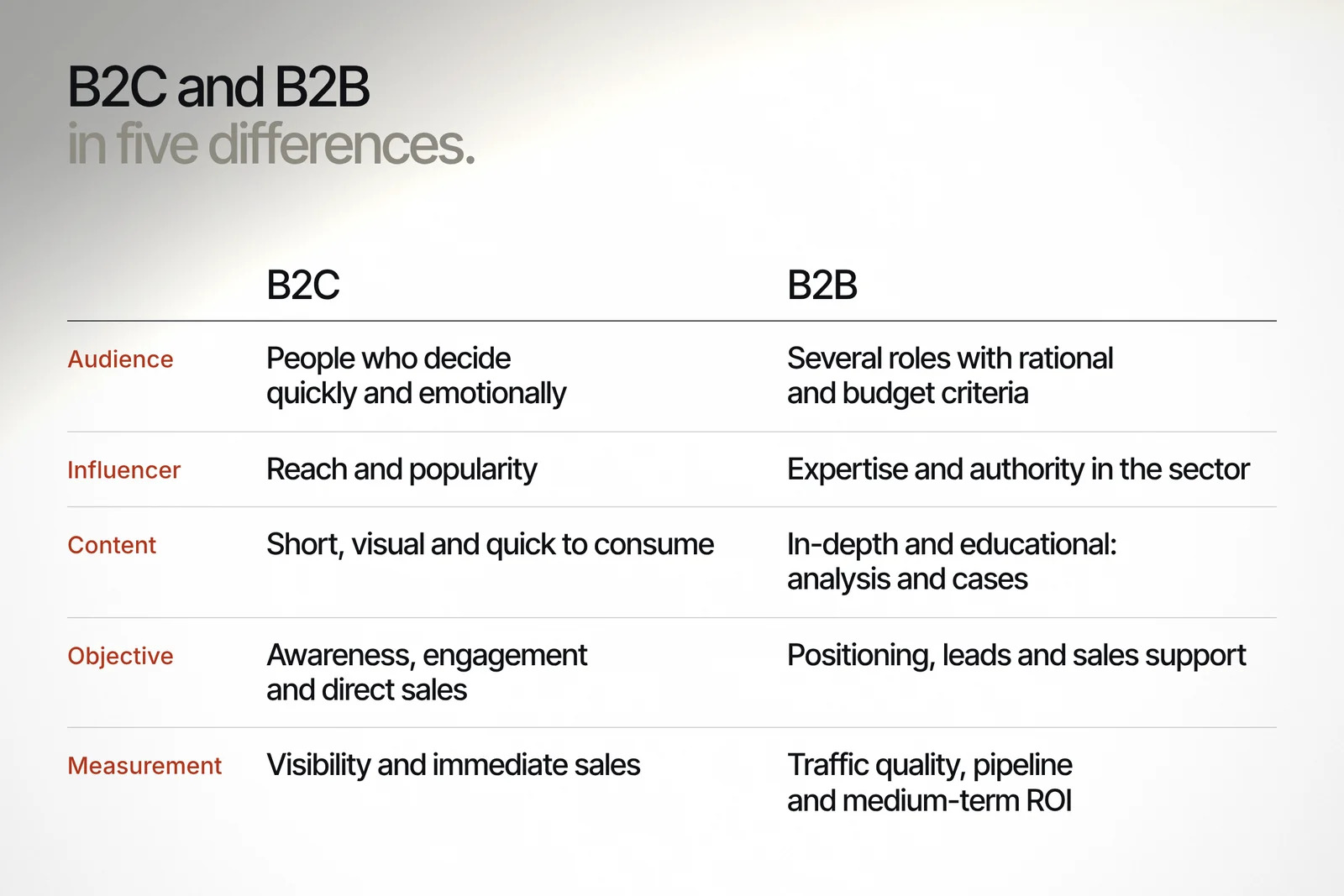
Although the concept is the same (influencing purchase decisions through credible voices), the dynamics, objectives and metrics of B2B and B2C influencer marketing show structural differences that directly affect execution and profitability.
Understanding these differences is key to designing effective strategies aligned with business objectives. In this article, you will be able to understand the main differences and approaches.
What Is B2B Influencer Marketing?
B2B influencer marketing is a strategy aimed at influencing complex purchase decisions within business environments. It is based on collaborating with professionals, industry experts and opinion leaders who have credibility and authority with specialist audiences. Unlike more commercial approaches, its main objective is not the direct sale, but building trust, positioning the brand and supporting the buyer through the different stages of the decision process.
In this context, the influencer’s value lies in their knowledge, experience and ability to generate relevant conversations that reach marketing, sales and management teams. B2B influencer marketing works as an accelerator of the sales cycle, providing external validation and reinforcing the perception of the brand as a benchmark in its sector.
What Is B2C Influencer Marketing?
B2C influencer marketing focuses on influencing end consumers through content creators with large, highly active communities. This approach prioritises visibility, engagement and emotional impact, with the aim of generating brand recognition and stimulating more immediate purchase decisions.
B2C collaborations are usually linked to consumer products, launches or promotions, and use agile, visual formats that make it easy to spread the message quickly. In this model, reach and the influencer’s ability to connect emotionally with their audience play a decisive role in the campaign’s success.
Key Differences Between B2B and B2C Influencer Marketing
As we outlined above, influencer marketing strategies differ widely depending on the approach, whether B2B or B2C. Below, we set out each of the differences so you can understand which is ideal for your business.
1 – Audience
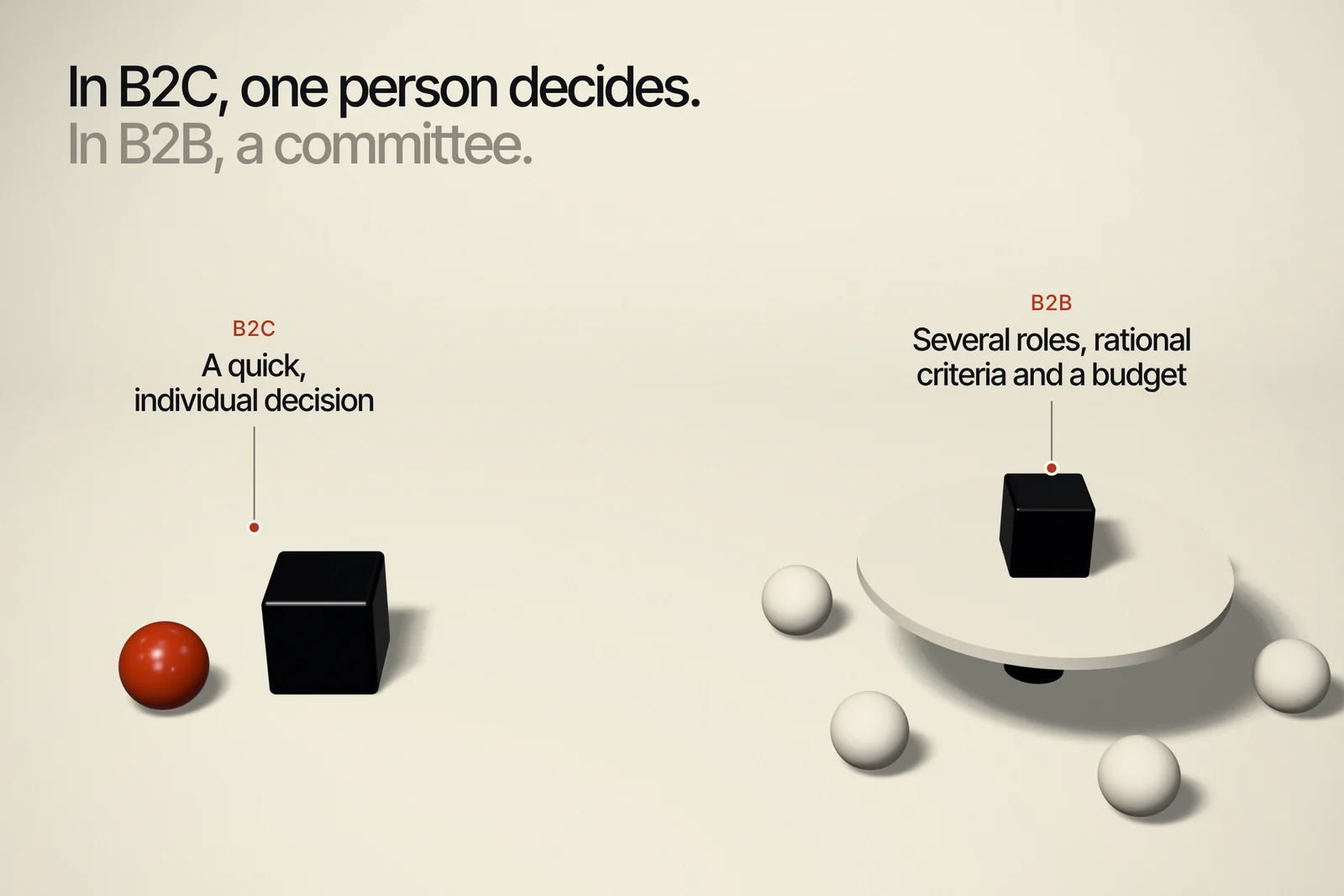
One of the main differences between the two approaches lies in the audience. In B2C, the message is aimed at individuals who make purchase decisions quickly and, in many cases, emotionally. In B2B, by contrast, decisions involve multiple profiles within an organisation and respond to rational, strategic and budgetary criteria.
2 – Influencer Profile
The influencer profile also varies significantly. While B2C prioritises reach and popularity, in B2B the decisive factor is expertise. B2B influencers are recognised professionals, with a track record and authority in their sector, able to exert influence through knowledge rather than fame.
3 – Type of Content
The type of content is another differentiating element. B2C influencer marketing relies on short, visual, quick-consumption formats designed to capture attention in highly competitive environments. In B2B, content is deeper and more educational, focused on analysis, use cases, real experiences and long-term value.
4 – Campaign Objectives
The objectives of each strategy also differ. In B2C, the focus is on awareness, engagement and direct conversion. In B2B, influencer marketing seeks to position the brand, generate qualified leads, accelerate consideration and support the sales team in building opportunities.
5 – Campaign Measurement
Finally, performance measurement follows different logics. In B2C, visibility and immediate sales metrics predominate, whereas in B2B the indicators analysed include traffic quality, influence on the sales pipeline and return on investment over the medium and long term.