
Photos, videos, reviews and testimonials created by real customers make it possible to show products in authentic contexts, reduce friction in the buying process and connect with potential customers through experience rather than sales talk. Implemented well, UGC turns visitors into buyers and buyers into ambassadors.
In this article, we explore the impact of UGC on conversion, the most effective strategies for online shops and the common mistakes worth avoiding, so you can make the most of its potential and turn the voice of your community into measurable results.
How UGC Affects Conversion Rates
User-generated content (UGC) has become one of the most powerful assets for online shops. In a digital environment saturated with advertising messages, people trust other people more than they trust brands. Incorporating user-generated content not only humanises the shopping experience, but also directly influences conversion rates, reducing friction and increasing trust at every stage of the funnel.
Below, we explain the main advantages of encouraging UGC and how they directly affect an online shop’s conversions.
Builds Brand Trust and Credibility
User-generated content acts as social proof in its purest form: shoppers trust other people’s experiences more than traditional advertising messages. This translates into faster purchase decisions and less friction in the decision-making process. In ecommerce, visitors who interact with UGC convert 102.4% more than the site average, which shows that real content breaks down barriers and generates instant trust.
Reduces Friction in the Buying Process
Including UGC on product pages, such as customer reviews, photos or videos, not only humanises the experience, but also helps answer the questions that naturally arise when buying online. This presence lifts overall website conversion by around 35% when UGC is implemented on product pages, category pages and paid ads, reflecting reduced uncertainty and more confident decision-making by the user.
Helps Customers Relate to the Product
UGC allows shoppers to see themselves reflected in real people who have already had the experience of using the product. This creates an emotional identification that goes beyond any institutional copy. Brands that integrate UGC into their product pages report that revenue per visitor increases by approximately 154%, showing that seeing other users enjoying a product noticeably encourages purchase.
Increases Time on Site and Engagement
Content generated by real customers does not just capture attention: it doubles, or more, the time visitors spend interacting with the pages where UGC is present. In fact, sites that display user-generated content report that visitors spend up to 90% more time on the website, which translates directly into greater engagement and higher conversion potential throughout the buying funnel.
Reinforces Purchase Decisions at Critical Moments
When a shopper is ready to decide, UGC can be the deciding factor. Social proof such as reviews, testimonials and visual content from users not only builds trust, but also increases conversions beyond the general average. Shops that integrate UGC see visitors who interact with these pieces convert more than twice as much as those who do not, which shows that, in the final stretch of the decision, real content carries far more weight than brand content.
Four UGC Strategies for Online Shops
Implementing UGC is not just a matter of “letting users speak”, but of creating the right conditions for that content to appear, be organised and have a real impact on conversion. These are some of the most effective strategies online shops can use to make the most of user-generated content.
1 – Enable Customer Reviews with Photos on Product Pages
Enabling reviews with real customer images on product pages is one of the most powerful UGC strategies for ecommerce. Photographs taken by consumers show the product in real contexts, with imperfect lighting and everyday settings, giving a far more honest impression than catalogue images.
This type of content helps resolve common doubts, such as size, texture, real-life use and final result, and speeds up the purchase decision. Photo reviews also enrich the page from an SEO perspective, increasing time on page and providing a constant stream of fresh content. When a user sees how other customers use the product, the experience becomes tangible and trustworthy, which directly affects conversion.

2 – Feature Honest Customer Testimonials
Authentic testimonials work as short accounts of real experience. They are not about perfect or overly polished phrases, but sincere opinions that reflect benefits, expectations and concrete results. In an online shop, these testimonials can be integrated into product pages, landing pages, emails or even ads.
What is truly valuable is that the potential customer encounters the voice of someone who has already been down the same path. This reduces uncertainty, reinforces trust and validates the brand’s promise. Honest testimonials do not just sell: they humanise, showing that behind the product there are real experiences, real people and credible results.
3 – Collaborate with Influencers in Your Industry
Influencer collaborations are a natural extension of UGC, provided authenticity is prioritised over reach. By working with content creators aligned with the industry and the brand’s values, an online shop can generate content that combines credibility, visibility and emotional connection.
Influencers act as advanced consumers: they try, recommend and contextualise the product within their everyday lives. This content can be reused across multiple channels, such as the website, social media and ads, amplifying its impact. The key is to choose profiles with real communities and allow them to communicate in their own language, generating high-quality UGC that does not come across as forced advertising.
4 – Encourage Customers to Create Content
UGC does not always appear spontaneously: it often needs a little nudge. Encouraging customers to create and share content is a key strategy for scaling this type of asset. Competitions, giveaways, branded hashtags, exclusive benefits or simple social recognition can motivate users to take part.
When an online shop actively invites its community to show how it uses its products, it not only obtains valuable content, but also strengthens its bond with its customers. This participation creates a sense of belonging and turns the consumer into an ambassador. The content created is also usually highly reusable and contributes a collective narrative that enriches the brand’s identity.
Common Mistakes When Using UGC in Online Shops
User-generated content can become one of the biggest conversion drivers for an online shop… or a missed opportunity if it is implemented without a strategy. These are the most frequent mistakes we see in ecommerce businesses that commit to UGC without clear planning, and that end up limiting its real impact.
Failing to Moderate or Curate Content
One of the most common mistakes is displaying all user-generated content without any filter or criteria. While authenticity is key, that does not mean all UGC adds value. Low-quality photographs, confusing messages or irrelevant experiences can affect brand perception and generate distrust. Curating content does not mean manipulating it, but selecting the pieces that best represent the product experience and the online shop’s identity.
HOW TO AVOID IT
Implement moderation and curation processes that prioritise quality, relevance and consistency with the brand.
Treating UGC as a Purely Visual Element
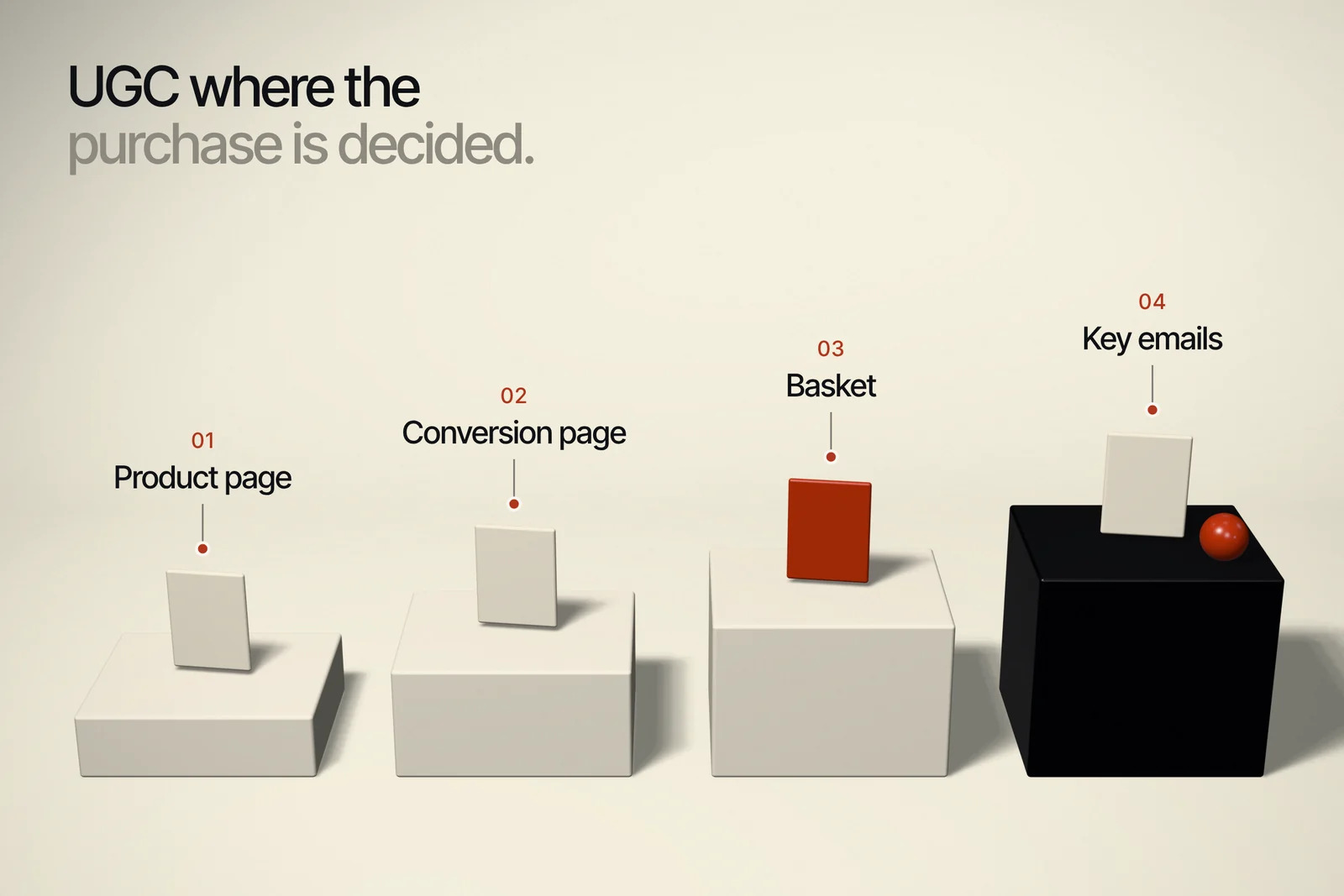
Many shops integrate UGC purely as visual decoration, without aligning it with business objectives. Placing customer photos “because they look good” without considering their position within the funnel reduces their impact. UGC is a strategic tool, not just an aesthetic one. Its true value appears when it supports the user’s decision-making at the key moments of the buying process.
HOW TO AVOID IT
Integrate UGC strategically into product pages, conversion pages, baskets and key communications.
Reusing Content Without Permission
Reusing customer content without explicit authorisation is a mistake that can lead to legal problems and damage the relationship with the community. Even if the content is public, that does not mean the brand has the right to use it commercially. Asking for permission also reinforces trust and improves the relationship with users, who feel valued and recognised.
HOW TO AVOID IT
Always request authorisation before reusing UGC and set out the conditions of use clearly and transparently.
Failing to Encourage Content Creation
Waiting for UGC to appear on its own usually produces limited results. Many brands rely solely on customer goodwill, without creating clear incentives to take part. Without incentives, the volume and variety of content are usually insufficient to generate a sustained impact.
HOW TO AVOID IT
Design specific actions to encourage participation: campaigns, benefits, visibility or clear rewards.
Not Measuring UGC’s Effect on Conversions
Implementing UGC without measuring results is another critical mistake. Many shops display user-generated content but do not analyse how it actually affects metrics such as conversion, time on site or basket abandonment. Without data, there is no optimisation or learning, and UGC becomes an under-used resource.
HOW TO AVOID IT
Define clear KPIs and analyse the impact of UGC at each stage of the funnel to optimise its use continuously.
Losing Control of Brand Messaging
Although UGC should be authentic, leaving it completely without direction can produce inconsistent messages or ones that stray from the brand’s positioning. This can confuse users and dilute the ecommerce brand’s identity. The balance between freedom and alignment is key if UGC is to add value rather than take it away.
HOW TO AVOID IT
Define clear guidelines on tone, values and content use, always maintaining the authenticity of the message.