
User-generated content (UGC) helps address this need through photographs, videos, reviews, testimonials and posts created from the perspective of consumers or content creators. Its value goes beyond offering a more relatable aesthetic: it provides evidence that can help reduce the doubts people have before making a purchase.
Achieving this requires more than collecting spontaneous videos. Brands need to identify which objections each piece of content should address and how it will fit into their wider commercial strategy.
Show the Product in a Real-Life Situation
One of the most effective ways to use UGC is to show a product in an everyday setting. Professional photography is essential for presenting product details, but user-generated content allows people to see how something works outside the studio.
A cosmetics brand can demonstrate a product’s texture and application; a fashion company can show how a garment looks on different body shapes; and a digital service can demonstrate how someone uses its features to solve a specific problem.
This kind of representation reduces the uncertainty between looking at a product and genuinely understanding its usefulness. It also helps establish more accurate expectations, particularly when size, colour, functionality or results are important to the purchase decision.
To increase conversions, each piece of content should focus on a specific situation. Trying to explain every benefit in a single video can result in something lengthy and unclear. One message, one need and one demonstration are often a far more effective combination.
Create Content That Addresses Objections
UGC shouldn’t be planned solely around the latest trends on a particular platform. It should also answer the questions and objections that arise during the buying process.
To identify these obstacles, brands can analyse social media enquiries, comments, frequently asked questions, reviews and reasons for abandonment. This research may reveal opportunities to create content around ease of use, price, durability, delivery, quality or product suitability.
For example, if some potential customers believe an item is difficult to use, a short tutorial can help change that perception. If their uncertainty relates to results, a video documenting someone’s experience over several days can provide a more convincing answer.
When UGC is developed around genuine objections, it stops being merely an attractive social media post and becomes a commercial asset that can bring potential customers closer to conversion.

Include Specific, Credible Testimonials
Testimonials can influence purchasing decisions, but not all of them are equally persuasive. A review saying “I loved it” communicates a positive experience, yet provides little useful information to someone still evaluating the product.
The most effective testimonials describe the initial situation, why the customer chose the product, their experience of using it and the outcome. The more specific the information, the easier it becomes to understand why a particular product might be useful.
Credibility also depends on tone. Overly promotional scripts can make content feel less natural. It’s worth establishing the key points that need to be communicated while allowing each person to explain them in their own words.
This doesn’t mean publishing every opinion without reviewing it. Brands must check that claims are accurate, that the content doesn’t make promises that are difficult to substantiate, and that it respects their values and communication guidelines.
Use UGC on Product Pages
UGC shouldn’t remain confined to social media. It can also be incorporated into the pages where people make purchasing decisions.
Demonstration videos, testimonials and customer photographs can be placed near product descriptions, prices or purchase buttons. This makes social proof available precisely when someone needs reassurance that the product is right for them.
Online shops can also create galleries featuring customer-submitted images, include verified reviews or provide visual answers to frequently asked questions. Service businesses can apply the same principle through short case studies, video testimonials or examples of results.
Placement is just as important as the content itself. If a video answers a question about how to use a product, it should appear close to the relevant explanation. If its purpose is to build trust, it might sit alongside a form or call to action. UGC should support the customer journey, not serve as decoration hidden at the bottom of the page.
Turn Your Best UGC into Adverts
UGC can be used as creative material in digital advertising campaigns. Its visual style often blends more naturally into social media, where people are accustomed to watching first-person videos, reviews, tutorials and recommendations.
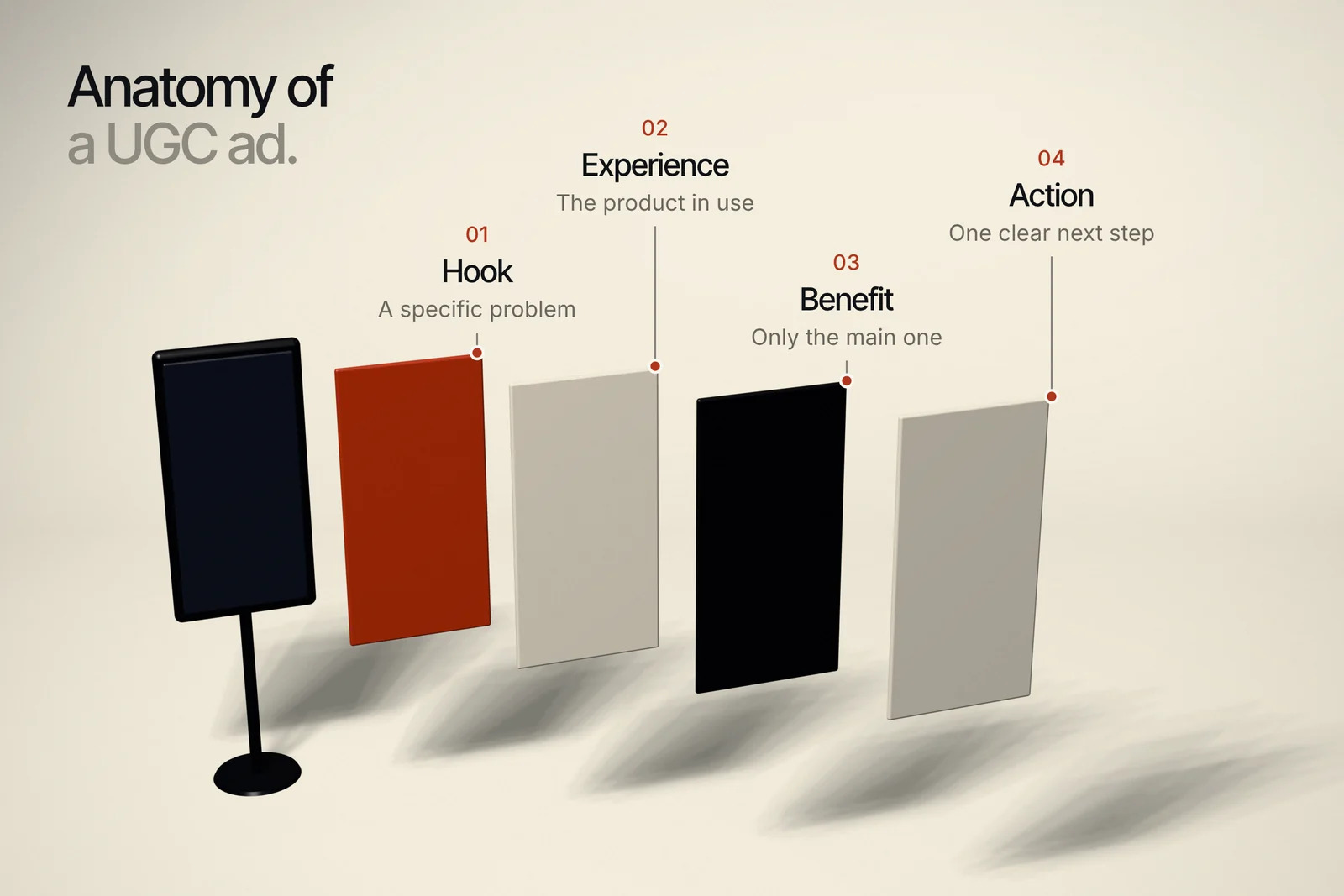
To create effective adverts, it’s advisable to begin with a statement or image that connects with a specific problem. The content should then demonstrate the experience, explain the main benefit and finish with an appropriate call to action.
Different approaches can also be tested for the same product: demonstrations, comparisons, common mistakes, first impressions, questions and answers, or experiences after several weeks of use.
However, using UGC doesn’t automatically guarantee strong performance. Different opening hooks, video lengths, creators, messages and calls to action need to be tested. A spontaneous appearance may capture attention, but a strategic structure is what guides people towards conversion.
Combine UGC with Influencer Campaigns
UGC and influencer marketing can complement one another within the same strategy. While UGC provides relatable, reusable visual assets, influencers offer access to communities that already know them and trust their judgement.
A collaboration might begin with content published on the creator’s own profile, followed by adapting that content for the brand’s other channels. If it performs well organically, the brand can also amplify it through advertising, provided the necessary permissions have been secured.
This combination allows brands to work on reach, consideration and conversion simultaneously. The creator introduces the product in a relevant context; the brand reconnects with interested users through adverts; and the sales page reinforces the decision with additional testimonials and demonstrations.
For a campaign to be effective, it’s essential to select creators whose audiences align with the target market. A large community can generate visibility, but a relevant audience increases the chances of meaningful engagement and sales.
Encourage Existing Customers to Create UGC
Brands can also encourage existing customers to share their experiences. This can be achieved through post-purchase emails, QR codes on packaging, competitions, specific hashtags or requests for reviews.
The process should be simple. It’s helpful to explain what type of content you’re looking for, how customers should submit it and whether there’s a benefit to participating. A future discount, a gift or the opportunity to be featured on the brand’s official channels may encourage contributions.
Before reusing a post, businesses must obtain permission. The fact that a photograph mentions a brand doesn’t mean it can automatically be used in adverts, on websites or in commercial campaigns.
It’s also worth establishing moderation criteria to check content quality, accuracy and alignment with the company’s brand identity.
Increase Your Brand’s Conversions with FlowFlamingo
UGC can bring a brand closer to its audience, address objections and turn real experiences into persuasive commercial messages. However, its performance depends on the strategy, creator selection, content quality and how that content is distributed.
At FlowFlamingo, we develop campaigns with influencers and content creators that align with each company’s objectives. We identify suitable creators, coordinate production and design strategies that connect creativity, trust and results.
If you want to use UGC to increase your brand’s conversions, we can help you turn customer experiences into content that supports purchasing decisions. Explore our services.