Influencer marketing is no longer a tactic aimed solely at brand awareness; it has become a strategic tool if your plans involve lead generation. In an increasingly competitive digital environment, companies are looking for effective ways to attract qualified contacts that can turn into real business opportunities. In this context, influencers play a key role thanks to their ability to connect with specific audiences, build trust and amplify commercial messages authentically.
Are Leads Generated Through Influencer Marketing Qualified?
The quality of leads obtained through influencer marketing depends, to a large extent, on the strategy planned beforehand. Although this type of campaign has high potential, there are frequent mistakes that can limit or even cancel out its effectiveness.
One of the main problems is poor influencer selection. Choosing profiles solely on follower volume, without analysing their affinity with the brand or the quality of their audience, usually results in contacts of little relevance. Another common mistake is the lack of conversion-oriented messages. Posts that are too generic or focused only on visibility do not encourage users to leave their details or move down the funnel.
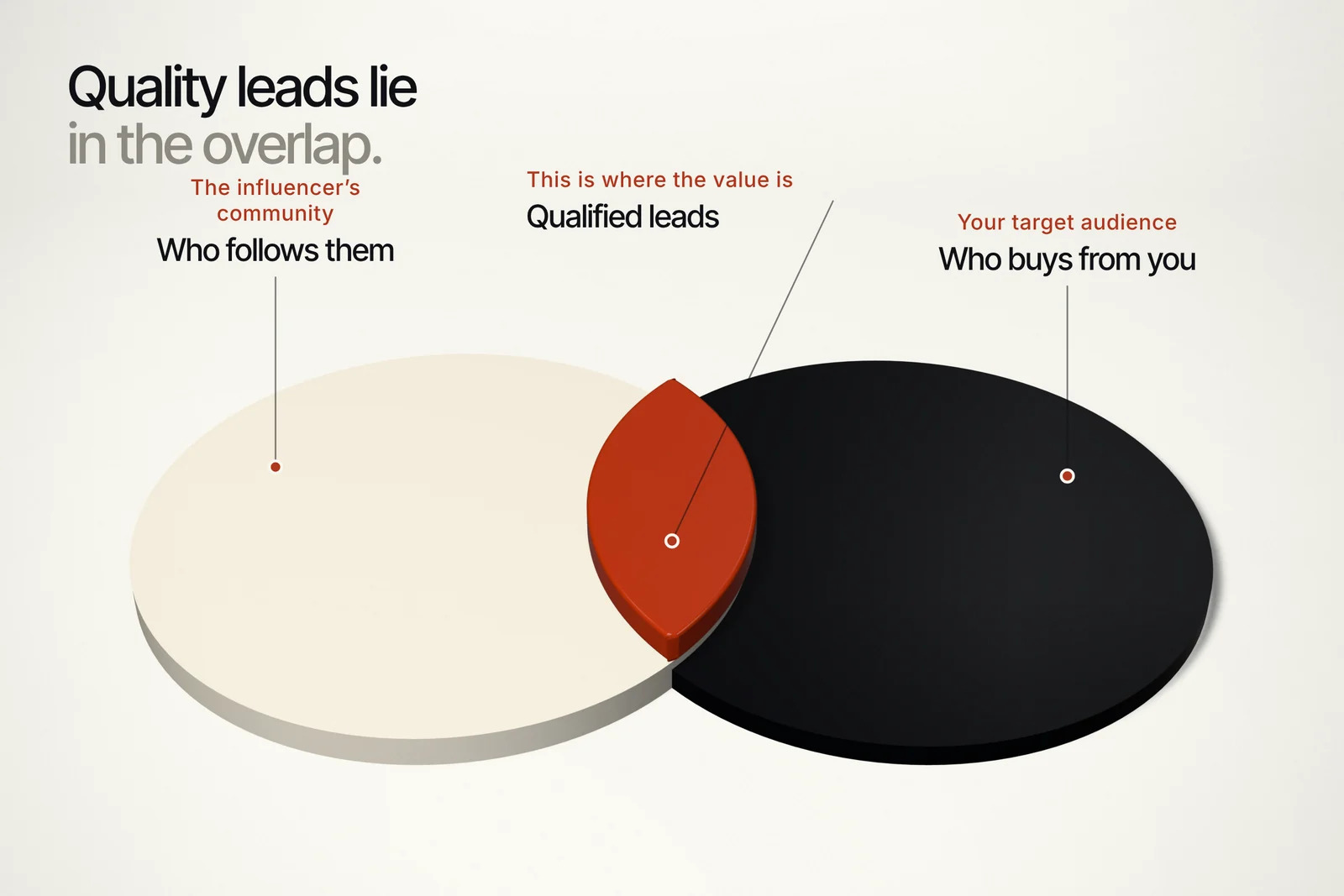
Likewise, confusing the influencer’s community with the brand’s community can create the wrong expectations. Not every audience is ready to become leads, and not every format works for capturing contacts. When these aspects are not taken into account, results tend to be ineffective.
If you plan an effective influencer marketing campaign, or partner with a specialist agency such as FlowFlamingo, the leads generated by the campaigns are designed to be fully qualified, as we take care of carefully selecting every content creator, defining the messages to be shared and evaluating the metrics to achieve the expected results.
How Can Influencers Help Your Business Generate Qualified Leads?
Influencer marketing can deliver significant results when it is integrated into a well-defined acquisition strategy. Influencers act as trusted intermediaries between the brand and its audience, which makes users more willing to interact, register or request information.
To generate qualified leads, it is essential to work with influencers who share the company’s values, tone and type of audience. The content must also be aligned with a clear value proposition and with the user’s stage in the conversion funnel.
When accurate targeting, relevant messages and an optimised conversion experience are combined, influencer marketing can become a highly efficient channel.
Benefits of Generating Leads Through Influencers
Running influencer marketing campaigns to obtain qualified leads is highly effective; among the benefits of using this type of strategy, we can highlight:
Building Trust Through Established Communities
One of the main benefits of influencer marketing in lead generation is its ability to build trust immediately. Influencers have built authentic relationships with their audiences over time, which means their recommendations are perceived as credible and relevant. When an influencer recommends a brand or invites their audience to engage with a specific value proposition, users tend to be more willing to leave their details and move forward in the conversion process.
More Natural Communication Than Traditional Advertising
Unlike other digital channels such as search or social media advertising, lead generation through influencers still has a lower level of saturation. This allows messages to stand out more easily and have a more direct impact on the audience. As a result, campaigns tend to achieve higher interaction rates and better attention from users.
Potentially More Efficient Marketing Investment
Influencer marketing can be a more cost-efficient alternative to other advertising formats. Especially when working with micro- or nano-influencers, it is possible to reach highly segmented audiences without the need for large investments. This can translate into a more competitive cost per lead and better optimisation of the marketing budget.
Access to Specific, Hard-to-Reach Audiences
Influencers allow brands to reach very specific communities, with defined interests and homogeneous behaviours. This access is especially valuable when the aim is to reach specific niches or user profiles that do not respond effectively to traditional advertising. Thanks to this natural segmentation, the leads obtained tend to show a higher level of affinity with the brand.
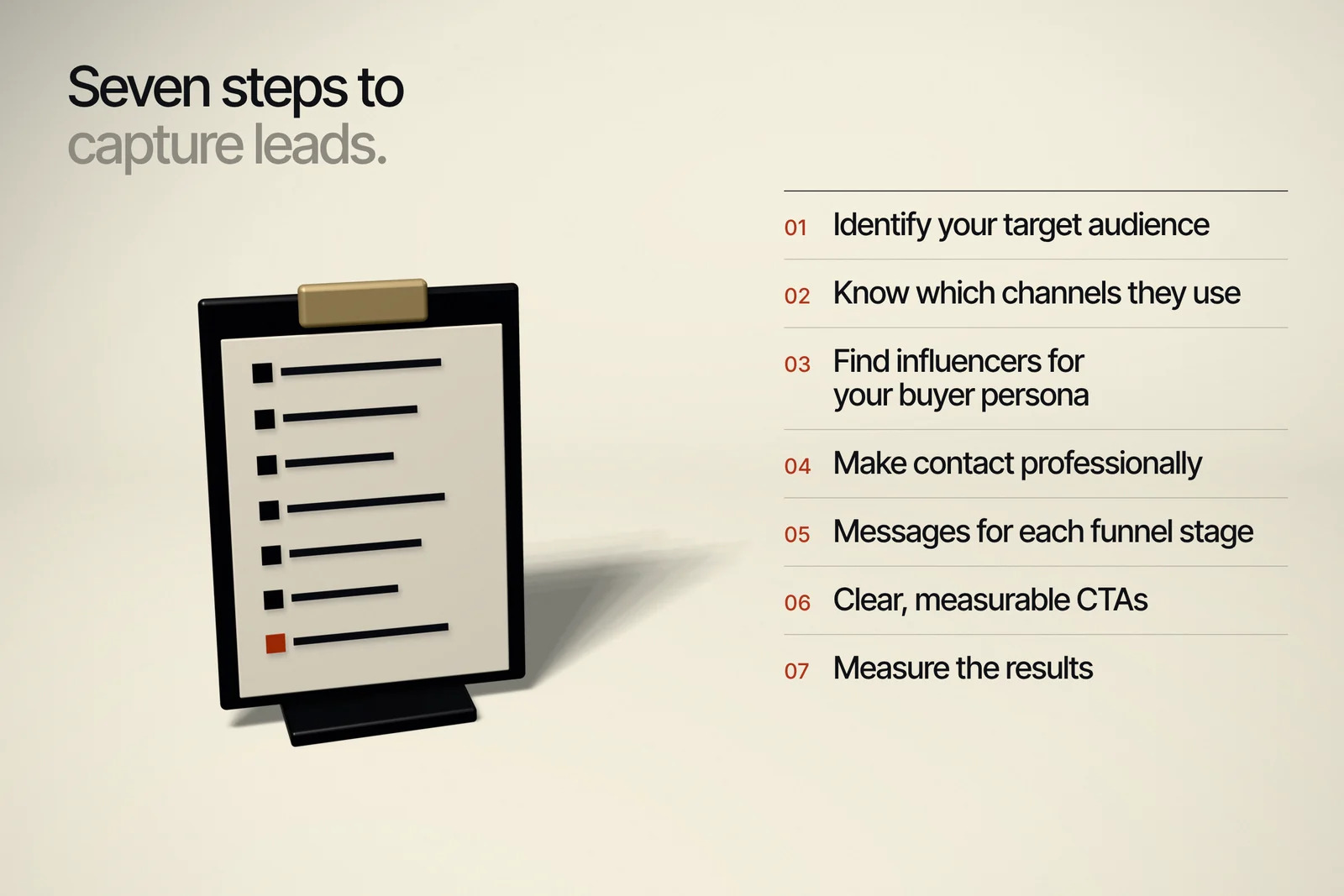
7 Steps to Plan an Influencer Marketing Lead Generation Campaign
1. Identify your target audience: The first step in ensuring the success of a lead-generation influencer marketing campaign is to define the target audience precisely. This involves analysing demographic, geographic and psychographic variables, as well as identifying the needs, interests and pain points of the audience you want to reach. A clear definition of the buyer persona makes it possible to design relevant messages and select influencers whose audience genuinely matches the profile you are looking for. Without this prior analysis, there is a high risk of capturing poorly qualified contacts that add no value to the business.
2. Understand which channels your target audience uses: Once the audience has been defined, it is essential to identify the digital platforms on which they interact most frequently. Each social network has different dynamics, formats and levels of intent. For example, TikTok and Instagram tend to be effective for generating awareness and engagement, while Facebook or LinkedIn can facilitate more direct lead capture. Understanding the target audience’s digital consumption habits makes it possible to prioritise the right channels and adapt the content to the most effective format for driving conversion.
3. Find influencers who reach your ideal customer: Influencer selection should be based on strategic criteria and not solely on follower numbers. It is essential to analyse the affinity between the influencer’s audience and the defined buyer persona, as well as metrics such as engagement, credibility and the type of content published. In this process, specialist partners such as FlowFlamingo are particularly useful, as they make it possible to identify relevant profiles, analyse objective data and ensure a selection aligned with the campaign’s lead-generation objectives.
4. Contact the selected influencers: Contact with influencers should be professional, clear and transparent. It is advisable to present the brand, the campaign objectives and the type of collaboration expected from the very first moment. Defining expectations, timings, formats and conditions helps avoid misunderstandings and makes for a smooth relationship between both parties. Well-structured communication helps the influencer understand the value of the proposal and get more effectively involved in lead generation.
5. Define campaign messages around the conversion funnel: Campaign messages should be designed with the audience’s stage in the conversion funnel in mind. Not every user is ready to become a lead straight away. It is therefore essential to adapt the content depending on whether the objective is to generate interest, educate the user or drive a specific action. This alignment between message and funnel improves the quality of the contacts obtained and increases conversion rates.
6. Include clear, measurable calls to action: Every lead-generation influencer marketing campaign must include clear, visible calls to action aligned with the conversion objective. These can lead to forms, landing pages, content downloads or contact requests. It is important that the CTA is easy to understand and that the process for leaving details is quick and accessible. A well-defined CTA is key to turning the attention generated by the influencer into measurable results.
7. Measure campaign performance: Measuring results is an essential step in evaluating the real impact of the campaign. It is necessary to analyse metrics such as the number of leads generated, the conversion rate, the cost per lead and the quality of the contacts obtained. This data makes it possible to identify which influencers, messages and channels have worked best. Based on this analysis, future campaigns can be optimised and the influencer marketing strategy continuously improved.